
Our Mass Energy Code Expert

Massachusetts Energy Code: Understanding Stretch Code and Specialized Code
Mon 02/02/2026 - 11:26 AM
Massachusetts Energy Code: Understanding Stretch Code and Specialized Code
Understanding and complying with the Massachusetts Energy Code is essential to delivering efficient, approvable, and future-ready buildings while contributing to the Commonwealth's ambitious decarbonization goals. This article breaks down the Base Code, opt-in Stretch Code, and opt-in Specialized Code so that building owners and developers can move forward with confidence.
The Massachusetts Energy Code landscape is evolving rapidly and has become a regulatory requirement, a financial consideration, and a sustainability commitment. Whether you are planning for new construction, an alteration, or a change of occupancy or use, the Massachusetts Energy Codes directly impact your design decisions, permitting timeline, and long-term operating costs.
Why Massachusetts Energy Code Compliance Matters for Building Owners and Developers
For building owners and developers, non-compliance can lead to costly delays, failed inspections, and denied permits. Beyond avoiding penalties, meeting Massachusetts energy codes offers significant advantages:
- Reduced operating costs through enhanced energy efficiency
- Improved building performance and occupant comfort
- Alignment with Massachusetts' climate action goals
- Enhanced property value and marketability
- Contribution to carbon reduction and decarbonization efforts
As Massachusetts advances toward net-zero emissions by 2050 via its Clean Energy and Climate Plan, staying ahead of energy code requirements positions your projects for long-term success in an increasingly sustainability-focused market.


Mass Energy Codes
What are the Massachusetts Energy Codes?

The Massachusetts Base Energy Code is part of the broader Massachusetts State Building Code (MSBC) and in the tenth edition, is based on the 2021 International Energy Conservation Code (IECC) with Massachusetts amendments. It establishes minimum energy efficiency requirements for residential buildings and commercial buildings, for both new construction and renovations to existing buildings.
Adoption of the IECC with Local Amendments
Massachusetts has adopted and amended the 2021 International Energy Conservation Code (IECC), tailoring it to meet the Commonwealth’s Clean Energy and Climate Plan for 2050. These amendments appear in the 780 CMR (Base code – tenth edition) and 225 CMR series (Stretch and Specialized codes).
Local Jurisdiction Enforcement
While the energy code is adopted at the state level, enforcement occurs locally. Each city or town—through its Authority Having Jurisdiction (AHJ) and building department—verifies compliance as part of the permitting and inspection process.
What Is the Current Energy Code in Massachusetts?
By December 2025, the 2025 Massachusetts Energy Code offers three distinct compliance pathways, each with increasing stringency: Base code, Stretch Code and Specialized Code.
SOCOTEC's dedicated team of energy code consultants, energy modelers, and building envelope consultants, can provide full-service code consulting for all code compliance paths in Massachusetts.
The Massachusetts Base Energy Code is part of the broader Massachusetts State Building Code (MSBC) and in the tenth edition, is based on the 2021 International Energy Conservation Code (IECC) with Massachusetts amendments. It establishes minimum energy efficiency requirements for residential buildings and commercial buildings, for both new construction and renovations to existing buildings.
Adoption of the IECC with Local Amendments
Massachusetts has adopted and amended the 2021 International Energy Conservation Code (IECC), tailoring it to meet the Commonwealth’s Clean Energy and Climate Plan for 2050. These amendments appear in the 780 CMR (Base code – tenth edition) and 225 CMR series (Stretch and Specialized codes).
Local Jurisdiction Enforcement
While the energy code is adopted at the state level, enforcement occurs locally. Each city or town—through its Authority Having Jurisdiction (AHJ) and building department—verifies compliance as part of the permitting and inspection process.
What Is the Current Energy Code in Massachusetts?
By December 2025, the 2025 Massachusetts Energy Code offers three distinct compliance pathways, each with increasing stringency: Base code, Stretch Code and Specialized Code.
SOCOTEC's dedicated team of energy code consultants, energy modelers, and building envelope consultants, can provide full-service code consulting for all code compliance paths in Massachusetts.
In Massachusetts, energy code compliance isn’t just about checking a box. It’s about aligning design, performance, and local requirements early on so projects move forward without costly delays. Early identification of the applicable energy code—Base, Stretch, or Specialized—is essential to avoiding redesigns, schedule impacts, and performance shortfalls. At SOCOTEC, we work directly with municipalities across Massachusetts, in conjunction with the Department of Energy Resources (DOER), to ensure clients' projects meet both state requirements and local expectations.
Base Code: 780 CMR
The Base Code, built on the IECC 2021 with state-specific amendments, applies to all Massachusetts municipalities by default and establishes minimum energy efficiency requirements for envelope performance, and mechanical, electrical, and lighting systems performance and controls.
Framework:
- Mandatory for all municipalities not adopting stretch or specialized codes
- Covers both residential buildings (780 CMR Chapter 11R) and commercial buildings (780 CMR Chapter 13). The residential code applies to Group R-2, R-3 and R-4 buildings three stories or less in height above grade; the commercial code applies to all other buildings, with the exception that multifamily buildings less than 12,000 square feet may pursue the residential code regardless of height.
- Introduces energy efficiency amendments to the 2021 IECC including requirements for electric vehicle and solar readiness, updated additional energy efficiency credit options and minimum thresholds, and revised total building performance analysis pathways, including HERS and Passive House.
Stretch Energy Code: 225 CMR 22.00 & 23.00
What is the Massachusetts Stretch Energy Code?
The Stretch Energy Code is an energy performance-based code adopted by many municipalities—often referred to as Stretch Code towns or communities. It sets more stringent performance requirements than the Base Code.
Framework:
- Based on 2021 IECC with MA amendments
- Residential low-buildings: 225 CMR 22.00
- Commercial buildings: 225 CMR 23.00
- Applies to both new construction and renovations (additions, alterations, and change of use)
- Often referred to as a thermal code, emphasizing heating and cooling load reductions via an efficient envelope (lowered U-values and air leakage limits, and considerations for thermal bridge derating) prior to specifying efficient equipment
What are the Massachusetts Stretch Energy Code towns?
As of 2025, over 270 cities and towns in Massachusetts have adopted the MA Stretch Code, including Boston, Cambridge, Lawrence, Lowell, Lynn, Newton, Quincy, Springfield, Worcester, and many more. It is also mandatory for towns designated as Green Communities. You can consult the list of MA Stretch Energy Code towns here.
Stretch Energy Code Compliance Pathways
Residential Buildings (225 CMR 22.00) – New Construction
There are three compliance pathways for new construction:
- Prescriptive Compliance: Only allowed for projects without individually separate dwelling units (for example, dormitories).
- Passive House (PHI, Phius) Compliance: Design certification is required through either Passive House Institute (PHI) or Passive House Institute US (Phius).
- HERS Compliance: Requires following EnergyStar Multifamily New Construction (ESMFNC) and achieving the code-required HERS index score.
Each of these performance pathways requires an additional efficiency package, and provides requirements for building envelope performance, including air leakage testing; efficient mechanical, service water heating, and electrical power/lighting systems; and electric vehicle and solar readiness.
Residential Buildings (225 CMR 22.00) – Existing Buildings
Exceptions apply for historic buildings if it is demonstrated to the code official or a representative of the historic preservation authority having jurisdiction that compliance would compromise the historic nature or function of the building.
- Additions: Applies when adding new floor area or converting unconditioned space to conditioned space. Smaller additions may comply with the Prescriptive or HERS pathways. Larger additions exceeding 1,000 square feet or 100% of the existing conditioned floor area are required to meet the applicable HERS score.
- Alterations, and Change of Occupancy or Use: Smaller alterations, or changes of occupancy or use, may comply with the Prescriptive or HERS pathways. Larger alterations (Level 3 alterations), or changes of occupancy or use, exceeding 1,000 square feet or exceeding 100% of the existing conditioned floor area, are required to meet the applicable HERS score.
Additions, alterations, and changes of occupancy or use may also comply with EnerPHit, which is the PHI’s passive house standard for existing buildings.
Commercial Buildings (225 CMR 23.00) – New Construction
There are five compliance pathways for new construction that may be combined in mixed-use buildings.
- Prescriptive Compliance: For non-residential buildings under 20,000 square feet.
- Targeted Performance Compliance: Can be used for any building. Required for certain municipal buildings, offices, K-12 schools, and residential or multifamily buildings over 12,000 square feet if Passive House or HERS are not pursued. Requires meeting the noted Thermal Energy Demand Intensity (TEDI) limits.
- Relative Performance Compliance: Created for high-ventilation buildings like labs and hospitals; available for any building type that is not required to follow TEDI. Requires an ASHRAE 90.1-2019 energy model to show compliance with Performance Energy Index (PEI).
- Passive House (PHI, Phius) Compliance: Can be used for any building type or size. Design certification is required through either Passive House Institute (PHI) or Passive House Institute US (Phius).
- HERS Compliance: Available for multifamily buildings. Requires following EnergyStar Multifamily New Construction (ESMFNC) and achieving the code-required HERS index score.
Each of these performance pathways provides requirements for building envelope performance, including air leakage testing; efficient mechanical, service water heating, and electrical power/lighting systems; systems commissioning; and electric vehicle and solar readiness.
Commercial Buildings (225 CMR 23.00) – Existing Buildings
Exceptions apply for historic buildings if it is demonstrated to the code official or a representative of the historic preservation authority having jurisdiction that compliance would compromise the historic nature or function of the building.
- Additions: Applies when adding new floor area or converting unconditioned space to conditioned space. Must comply as if new construction, with the Prescriptive Path only applicable to buildings under 20,000 square feet.
- Alterations: Work that is not an addition, repair, maintenance, or change of occupancy or use. Only modified portion must comply with the base code; also applies whenever the existing roof, wall or floor cavity.
- Change of Occupancy or Use: For spaces undergoing a change of occupancy or use, and demonstrating an increase in total modeled annual fossil fuel or total modeled energy use. Must comply as if new construction; where the change of use is the whole building, the whole building must comply as if new construction – Prescriptive Compliance is an option regardless of square footage.
Additions, alterations, and changes of occupancy or use may also comply with EnerPHit, which is the PHI’s passive house standard for existing buildings.
Opt-In Specialized Code: 225 CMR 22.00 + Appendix RC & 225 CMR 23.00 + Appendix CC
What is the Massachusetts Specialized Energy Code?
The Specialized Energy Code is a municipal opt-in code built on the Stretch Code with additional appendices, applicable to new construction only. It is designed to align new construction with the state’s Clean Energy and Climate Plan for 2050 by prioritizing decarbonization and reducing reliance on fossil fuels.
Framework:
- Requires Stretch code compliance as a baseline
- Residential: 225 CMR 22.00 plus Appendix RC
- Commercial: 225 CMR 23.00 plus Appendix CC
- Mandates significant electrification and renewable energy provisions
What are the MA Specialized Energy Code towns?
More than 50 towns and communities have adopted the Specialized energy code, including Cambridge, Brookline, Somerville, Newton, and more. A full list of participating municipalities is available on the DOER's website.
Specialized Energy Code Compliance Pathways
Under both Appendix RC and Appendix CC, one of three pathways must be selected in conjunction with meeting the new construction requirements of the Stretch Codes.
- Zero Energy Pathway: Buildings must demonstrate that they will result in net zero energy consumption over the course of a year. HERS 0 and Phius ZERO are optional compliance paths.
- All-Electric Pathway: No fossil fuel may be used for space heating, water heating, cooking, or drying. For buildings pursuing the HERS pathway, the allowable index score is more stringent than that permitted by the Stretch Code.
- Mixed Fuel Pathways: Buildings that use on-site fossil fuels (excluding use in emergency equipment) must be pre-wired for future electrification and must install equipment for on-site renewable energy.
For projects subject to 225 CMR 23.00, the Specialized Code for commercial construction requires Passive House compliance for multifamily buildings exceeding 12,000 square feet.
Mass Energy Code Compliance
How Is MA Energy Code Compliance Verified?
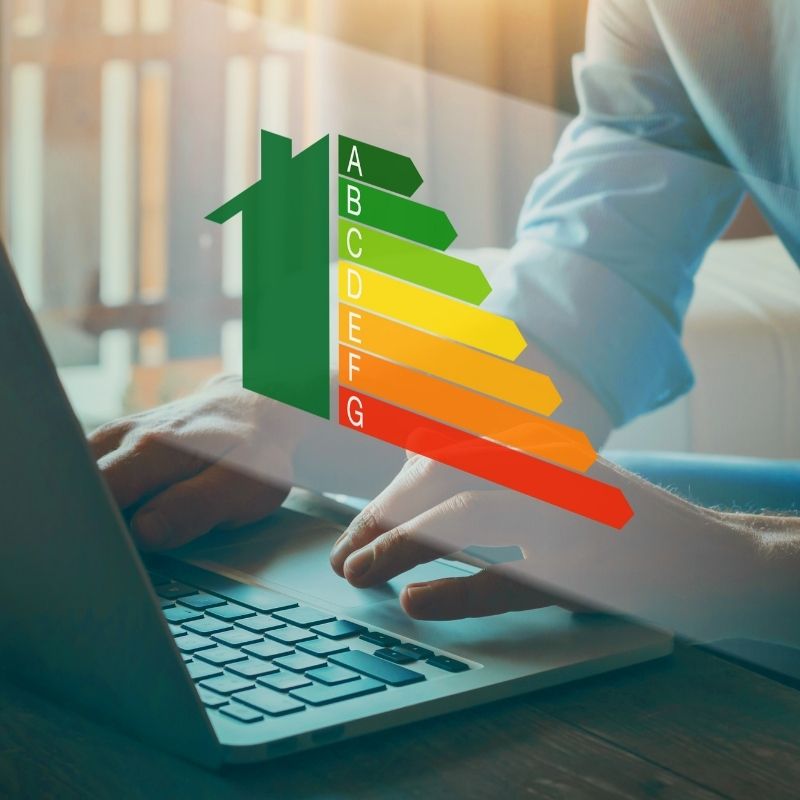
Verification is a multi-step process requiring coordination between design teams, building and energy consultants, and AHJs.
Energy Modeling
Whole-building energy modeling is used to demonstrate compliance with Massachusetts Energy Code performance targets under the TEDI, Relative Performance, Passive House, or HERS compliance pathways using DOER-approved software and supported by clear, complete documentation suitable for AHJ review.
COMcheck and REScheck Tools
COMcheck and REScheck are energy compliance software tools developed by the United States Department of Energy (DOE).
- COMcheck: Used for commercial buildings. Under the Stretch Code, COMcheck Envelope is only required for projects pursuing Prescriptive Compliance; COMcheck Lighting and Mechanical are required for all project compliance pathways.
- REScheck: Used for low-rise residential buildings following the Prescriptive Compliance pathway.
Coordination with Authorities Having Jurisdiction ( AHJ)
Early engagement with your code consultant and AHJs reduces the risk of misinterpretation, especially when navigating Existing Buildings provisions.
Verification is a multi-step process requiring coordination between design teams, building and energy consultants, and AHJs.
Energy Modeling
Whole-building energy modeling is used to demonstrate compliance with Massachusetts Energy Code performance targets under the TEDI, Relative Performance, Passive House, or HERS compliance pathways using DOER-approved software and supported by clear, complete documentation suitable for AHJ review.
COMcheck and REScheck Tools
COMcheck and REScheck are energy compliance software tools developed by the United States Department of Energy (DOE).
- COMcheck: Used for commercial buildings. Under the Stretch Code, COMcheck Envelope is only required for projects pursuing Prescriptive Compliance; COMcheck Lighting and Mechanical are required for all project compliance pathways.
- REScheck: Used for low-rise residential buildings following the Prescriptive Compliance pathway.
Coordination with Authorities Having Jurisdiction ( AHJ)
Early engagement with your code consultant and AHJs reduces the risk of misinterpretation, especially when navigating Existing Buildings provisions.
As energy code consultants, we recommend scheduling pre-submittal meetings with building departments when the option is available in respective jurisdictions. This collaborative approach identifies potential issues before they become costly problems. Our role is to simplify compliance while helping project teams achieve performance goals that make sense technically and financially.
Massachusetts Energy Code Consultants
An energy consulting firm such as SOCOTEC can guide you throughout the entire project lifecycle to ensure compliance with Massachusetts building and energy codes, including the Base Code (780 CMR), Stretch Code (225 CMR 22.00 and 23.00), and Specialized Code (Appendix RC and CC) requirements. Early involvement minimizes costly design changes, identifies the most efficient compliance pathway, and streamlines the process from design through final certification.
At SOCOTEC, we provide comprehensive services for Massachusetts energy codes compliance, combining local energy code expertise with nationwide building envelope experience.
- Energy Code Compliance Verification – Review designs against Base Code, Stretch Code, and Specialized Code requirements
- Energy Modeling & Performance Analysis – Building simulation and system performance evaluation, including TEDI and Relative Performance compliance modeling
- Passive House Consulting – Design guidance and verification for Passive House Institute US (Phius) compliance
- HERS Consulting – Design guidance and verification for Home Energy Rating System compliance
- Green Building Certification (LEED, WELL, EGC) – Consulting and documentation support for sustainable building certifications
- Building Envelope Testing – Air barrier testing, thermal imaging, and envelope performance verification
- Documentation & Permitting Support – Preparation of compliance forms and permit documentation
- Plan Review Services – Technical review of drawings to identify compliance issues pre-construction
- Construction Phase Inspections – On-site verification of code-compliant installation
- Commissioning Services – Systems verification, performance testing, and as-built documentation
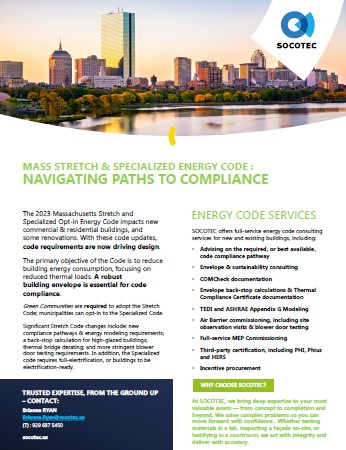
Download our Massachusetts energy code PDF
Ready to Ensure Your Project Meets Massachusetts Energy Code Requirements?
FAQ: Massachusetts Energy Code
Sources:
- Massachusetts Clean Energy and Climate Plan for 2050: https://www.mass.gov/info-details/massachusetts-clean-energy-and-climate-plan-for-2050
- Massachusetts State Building Code - 780 CMR: https://www.mass.gov/massachusetts-state-building-code-780-cmr
- Massachusetts State Building Code - 225 CMR: https://www.mass.gov/law-library/225-cmr
- Mass Energy Code Towns: https://www.mass.gov/doc/building-energy-code-adoption-by-municipality/download
You may also like




Get the latest updates about SOCOTEC, subscribe to our newsletter!