
Forensic Investigation of the Davenport Building Collapse in Iowa
A historic Iowa building suffered a partial structural failure. SOCOTEC delivered a full forensic analysis and root cause investigation behind this catastrophic collapse to support community safety and future risk management.
Key Information
Project Name: Forensic Investigation of The Davenport Building Collapse
Client: City of Davenport (supporting multiple public stakeholders)
Location: Davenport, Iowa
Services Provided: Forensic engineering, structural analysis, root cause analysis, on-site investigation, construction document review, expert consultation

Talk to our experts

The Challenge
A Tragic Building Collapse in Iowa
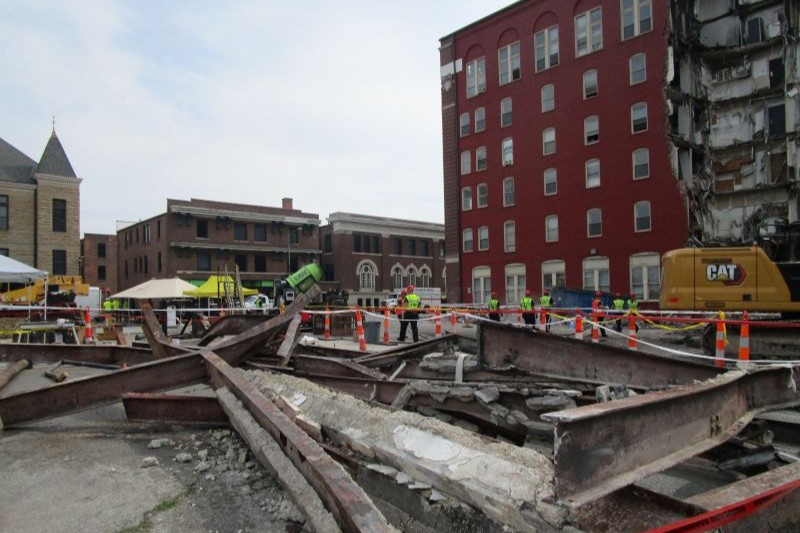
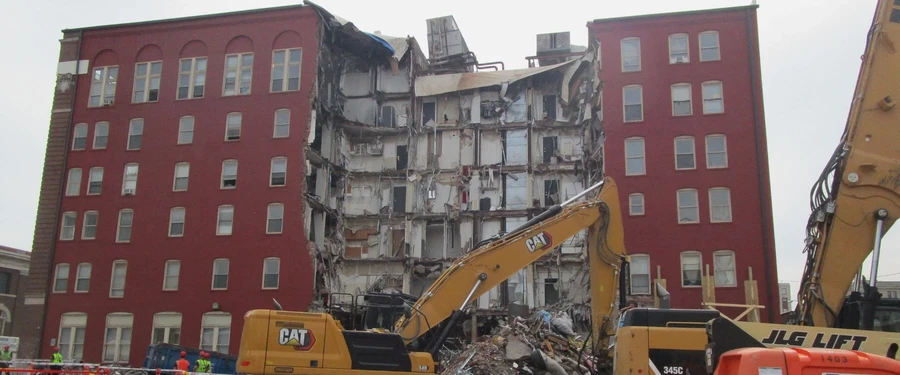
The Davenport Building Collapse marked one of Iowa’s most significant recent structural failures when a portion of the west façade of The Davenport unexpectedly gave way in May 2023. The incident—resulting in fatalities, injuries, and widespread community impact—prompted a need for a clear, evidence-based understanding of what caused the building to fail.
Originally built in 1907 with load-bearing brick masonry walls of varying thickness, the structure had undergone more than a century of modifications and experienced long-term deterioration. These conditions made the building particularly vulnerable during the repair work being performed just days before the collapse.
The most critical challenge arose when contractors removed several wythes of deteriorated masonry from the west façade. This created eccentric loading and bending stresses that the wall was never designed to support. Temporary shoring was inadequate for the building’s structural demands, and construction oversight during this high-risk phase was limited.
SOCOTEC’s task was to reconstruct the sequence of events, analyze the structural behavior leading up to the failure, and help stakeholders understand the broader risk management implications for historic and aging buildings.
The Davenport Building Collapse marked one of Iowa’s most significant recent structural failures when a portion of the west façade of The Davenport unexpectedly gave way in May 2023. The incident—resulting in fatalities, injuries, and widespread community impact—prompted a need for a clear, evidence-based understanding of what caused the building to fail.
Originally built in 1907 with load-bearing brick masonry walls of varying thickness, the structure had undergone more than a century of modifications and experienced long-term deterioration. These conditions made the building particularly vulnerable during the repair work being performed just days before the collapse.
The most critical challenge arose when contractors removed several wythes of deteriorated masonry from the west façade. This created eccentric loading and bending stresses that the wall was never designed to support. Temporary shoring was inadequate for the building’s structural demands, and construction oversight during this high-risk phase was limited.
SOCOTEC’s task was to reconstruct the sequence of events, analyze the structural behavior leading up to the failure, and help stakeholders understand the broader risk management implications for historic and aging buildings.
SOCOTEC’s Forensic Approach and Engineering Solutions
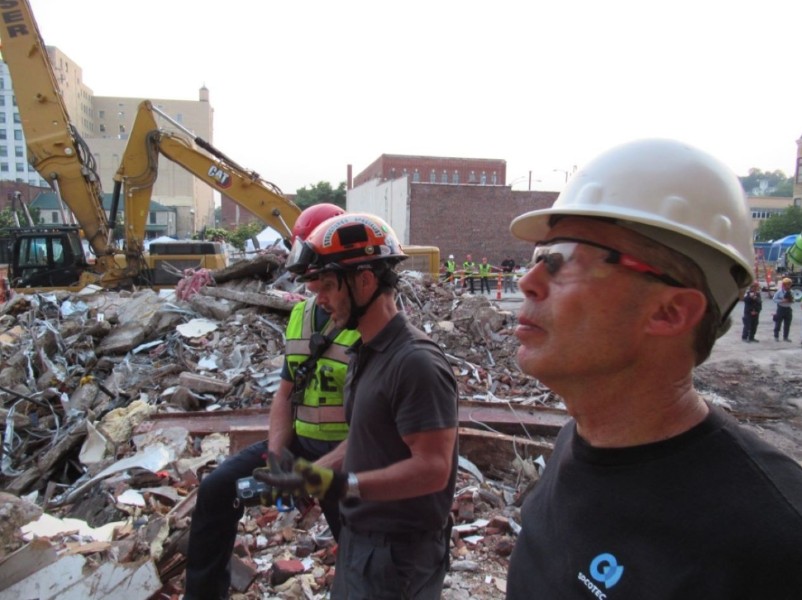
SOCOTEC delivered a full suite of forensic analysis and engineering services to help public officials, first responders, and stakeholders understand how and why this building collapse occurred. Our team implemented rigorous technical procedures to ensure a transparent, defensible, and accurate investigation.
Key Benefits and Lessons from SOCOTEC’s Analysis
SOCOTEC’s investigation delivered several key benefits:
Clear root cause identification to support informed decision-making and public communication.
Stronger risk management practices for future structural repairs and building maintenance.
Improved understanding of historic masonry vulnerabilities, helping prevent similar failures.
Guidance on proper documentation, stabilization, and engineering oversight during high-risk construction activities.
Support for community safety efforts through transparent, evidence-based forensic analysis.
Have a question about your building’s safety or structural integrity?
Contact us to speak with one of our experts.