
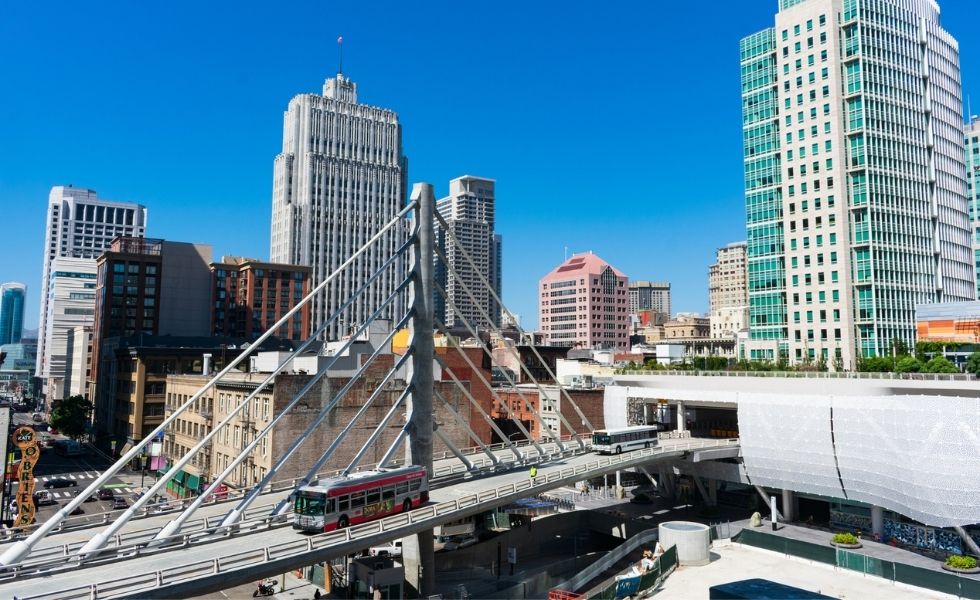
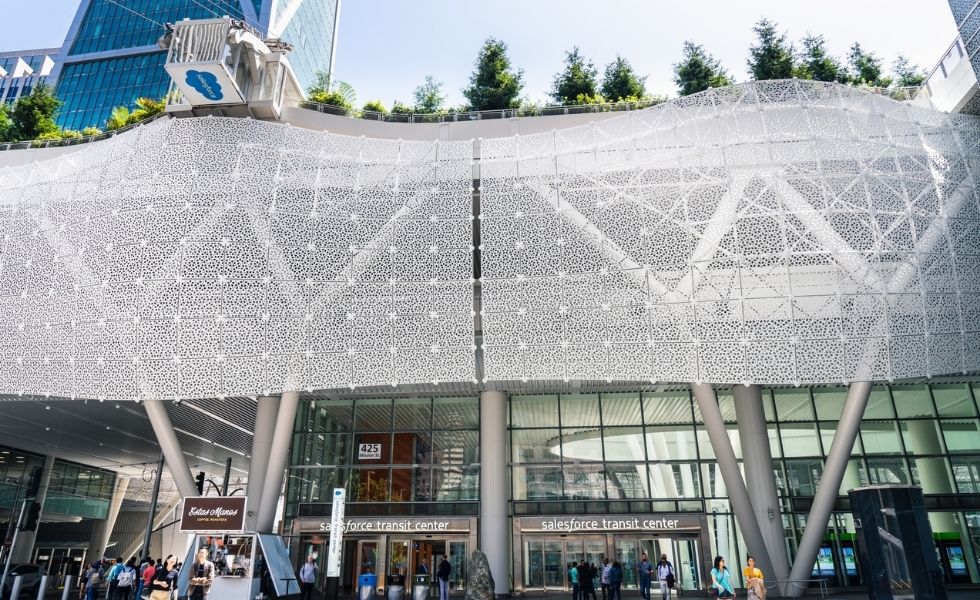
Salesforce Transit Center – San Francisco, CA
Photo: Jason O'Rear
SOCOTEC conducted a comprehensive forensic engineering investigation and root-cause analysis following the discovery of fractured girders at the Salesforce Transit Center, a major transportation hub in the San Francisco Bay Area.
Key Information
Project Name: Root Cause and Fitness-For-Service Assessments of the Transbay Transit Center Fractured Girders
Client: Transbay Joint Powers Authority (TJPA)
Location: San Francisco Bay Area, California
Services Provided: Root-cause investigation, Failure analysis, Forensic engineering consulting, Finite element analyses (FEA), Fitness-for-service assessment

Talk to our experts



The Challenge
Investigating Structural Fractures in a Major Transportation Hub
The Salesforce Transit Center in San Francisco, California, is one of the most significant infrastructure projects in the Bay Area. Designed as a multi-level transportation hub, the facility connects regional transit networks, while offering a unique urban amenity: a 5.4-acre rooftop park stretching approximately 1,400 feet along the structure. Opened to the public in August 2018, the transit center quickly became a landmark in downtown San Francisco.
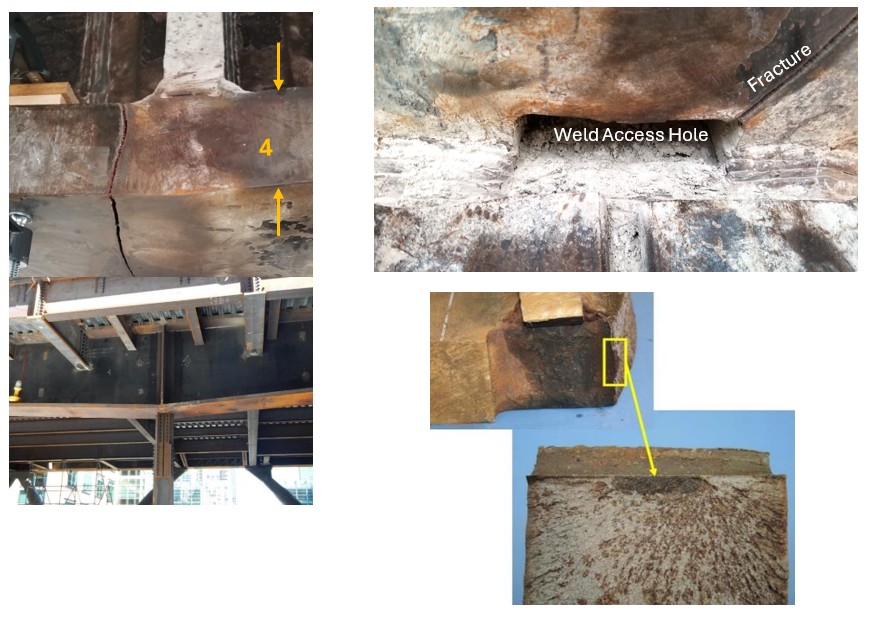
Shortly after opening, unexpected structural fractures were discovered in September 2018 in the bottom flanges of two girders. The fractured girders presented immediate safety concerns:
- Cracks originated at weld access holes adjacent to vertical hanger connections
- Fractures extended across the entire half-width of the 4-inch thick flanges at three separate locations
- The structural integrity of this regional transportation hub was compromised
This situation demanded immediate forensic investigation to determine the failure mechanism, assess structural fitness-for-service, and ensure long-term performance of the facility.
Given the complexity of the structure and the importance of the transit center to the region’s infrastructure, Transbay Joint Powers Authority (TJPA) required a forensic engineering consultant capable of performing a rigorous root-cause investigation and assessing whether the structure remained safe and suitable for service.
The Solution
Multidisciplinary Forensic Investigation and Root-Cause Analysis
SOCOTEC conducted a comprehensive forensic engineering investigation to identify the failure mechanism and determine the root-cause of the fractured girders. The approach combined advanced analytical modeling, materials evaluation, and fracture mechanics to develop a clear understanding of the structural behavior.
The forensic investigation included several advanced analyses:
- Metallurgical evaluations to assess the material condition of the steel components
- Material testing following established industry standards
- Fracture mechanics assessments to understand crack initiation and propagation
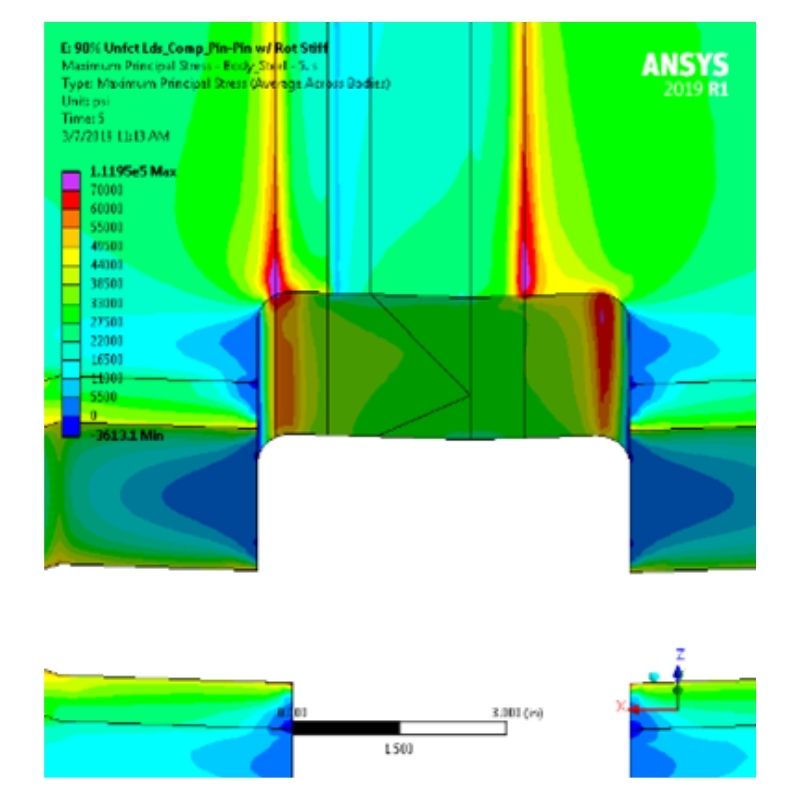
- Finite Element Analyses (FEA) to evaluate structural behavior and perform detailed stress analysis of the girders and connections
Through this investigation, SOCOTEC determined that shallow surface microcracks formed during the thermal cutting of weld access holes during fabrication. Under the influence of welding-induced residual stresses, these microcracks propagated and developed into larger “pop-in” cracks within the girder flanges.
To confirm the structural implications of these findings, the team conducted a fitness-for-service evaluation using the Failure Assessment Diagram (FAD) methodology, in accordance with API 579-1 / ASME FFS-1. This work incorporated:
- Stress intensity factor calculations
- Residual stress distribution analysis
- Fracture toughness testing
All analyses were performed in accordance with recognized engineering standards, including ASTM specifications, AWS D1.1, and ASME codes.
SOCOTEC conducted a comprehensive forensic engineering investigation to identify the failure mechanism and determine the root-cause of the fractured girders. The approach combined advanced analytical modeling, materials evaluation, and fracture mechanics to develop a clear understanding of the structural behavior.
The forensic investigation included several advanced analyses:
- Metallurgical evaluations to assess the material condition of the steel components
- Material testing following established industry standards
- Fracture mechanics assessments to understand crack initiation and propagation
- Finite Element Analyses (FEA) to evaluate structural behavior and perform detailed stress analysis of the girders and connections
Through this investigation, SOCOTEC determined that shallow surface microcracks formed during the thermal cutting of weld access holes during fabrication. Under the influence of welding-induced residual stresses, these microcracks propagated and developed into larger “pop-in” cracks within the girder flanges.
To confirm the structural implications of these findings, the team conducted a fitness-for-service evaluation using the Failure Assessment Diagram (FAD) methodology, in accordance with API 579-1 / ASME FFS-1. This work incorporated:
- Stress intensity factor calculations
- Residual stress distribution analysis
- Fracture toughness testing
All analyses were performed in accordance with recognized engineering standards, including ASTM specifications, AWS D1.1, and ASME codes.
The Results
Clear Findings and Engineering Guidance for Critical Infrastructure
This structured and technically rigorous approach allowed SOCOTEC to provide the client with a clear root-cause determination, supporting informed decisions regarding the structural integrity of this critical San Francisco Bay Area infrastructure.
Key outcomes included:
- Identification of the root cause of the girder fractures, linked to microcracks introduced during thermal cutting and propagated by welding-induced stresses
- Detailed stress analysis and structural modeling using finite element analyses
- Comprehensive fitness-for-service evaluation based on recognized international engineering standards
- Independent forensic engineering expertise supporting informed decisions regarding repair and structural integrity
The investigation provided the client with the technical understanding required to address the issue while maintaining a focus on public safety and infrastructure reliability.
By combining advanced computational modeling, fracture mechanics, and materials science, SOCOTEC helped ensure long-term structural integrity of the Salesforce Transit Center.

Want rigorous Forensic Engineering guidance for your complex Infrastructure Assets?